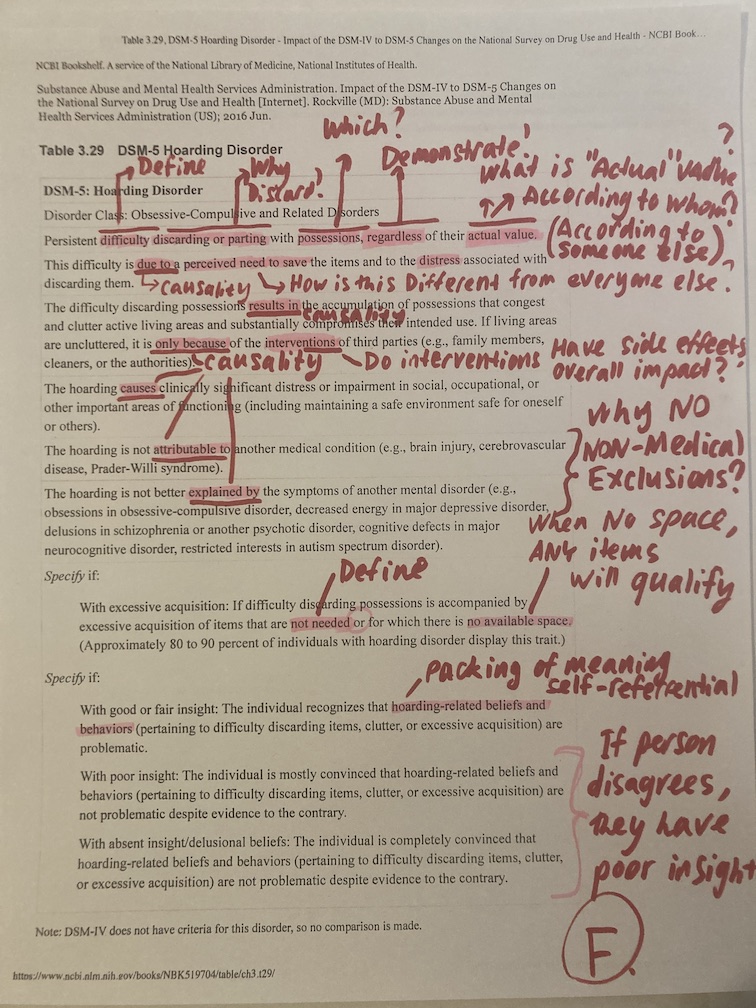
Effectively the only reliable and demonstrable clause is the mechanical condition that I have termed "dysfunction in possessions" - DIP ( only I don't attribute any further stipulations or assumptions to it ).
It should also be noted that in books or elsewhere or in coloquial use, definition is almost never applied rigorously - a pronouncement of the "hoarding" diagnosis is made informally and implicitly, based solely on any or all of - dysfunction in possessions, unusual / excessive acquisition, amount or nature of the items in question, refusal to comply with discarding demands.
Also, the DSM-5 definition, or any definition of "hoarding", does not distinguish between possibly completely unrelated underlying factors, causes, intentionality, reasons for acquiring / keeping, other contributing factors, etc.
Thus, it appears both too broad / ambiguous ( cf. Pachydermata ), on one hand, and on the other, it does not inform us of anything useful for treatment / mitigation.
It is also full of difficult-to-prove, easy-to-assume causality - both literal "caused by" and "causes" clauses, and variants like "attributed to", "explained by", "leading to", "results in", "due to", etc. - literally every single clause contains one of these.
Causation is remarkably difficult to demonstrate ( correlation does not imply causation ) - and with so much causation claimed in the definition, conclusively demonstrating all of it would be a nightmare ; in practice, this appears to be glossed over - e.g. in hoarding books, we never see this applied rigorously, or at all. Nor in clinical practice and in colloquial usage.
Here are all the issues I see with it -
* vague, subjective, relying on arbitrary "actual value" judgement, implicitly meant to be "by someone other than the individual"
* "actual value" does not exist - value is highly context dependent, as can be easily demonstrated, and as I have demonstrated
* "regardless of actual value" ( whatever we consider the "actual value" to mean, for the sake of the argument ) can be demonstrated false in most cases - does the person discard anything at all ( see their kitchen garbage or recycling bin ) - unless we short-circuit "actual value" to mean "value according to the judgement of someone other than the individual"
* much of it is broad enough to fit a lot more situations, or a lot less, as desired
* effectively, the only observable and provable clause is the one about clutter / impairement of usage
* never seen applied rigorously ( in my experience, in all of the books and speeches by "experts" that I studied, anywhere really )
* an umbrella term - accepts completely unrelated situations, reasons for keeping, does not even consider intentionality
* does not consider non-medical, non-mental-illness exclusions - such as shortage of resources, lack of knowledge, life events
* once we try to address any of these nuances, making implicit assumptions explicit, adding missing exclusions, etc. - it get ugly and intractable real fast, and/or starts excluding most individuals currently considered
* if we allow for sufficient resources ( money, time, space ), provide knowledge and removal of external stress - supposedly clinical "disorder" might.. vanish ? what kind of condition can be cured by basic resources and knowledge ?
Honestly, all of it feels to me rather like someone's sloppy homework, hastily completed on the last day, and slipped under the door. I graded it, and I gave it.. an F.
Is there a way to fix this, is there a better way to have such a definition ?
Let's ask - what is the definition actually useful for ? From what I've seen, nothing that benefits the individual, and everything that harms them.
In my opinion, no, there is no improved definition possible, nor a need for one - the whole concept is an error - same as "pachydermata" - better to consider specific objective aspects, approaching each situation without prejudice, building a profile of the situation, asking general troubleshooting questions, and guiding solutions accordingly.