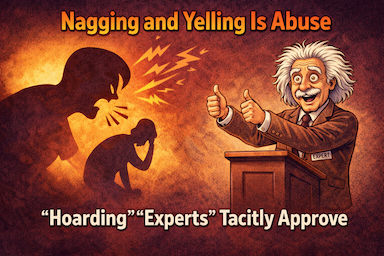
I will take a very uncompromising stance on this - I spoke about this before, but I have since come to realize it's much, much worse.
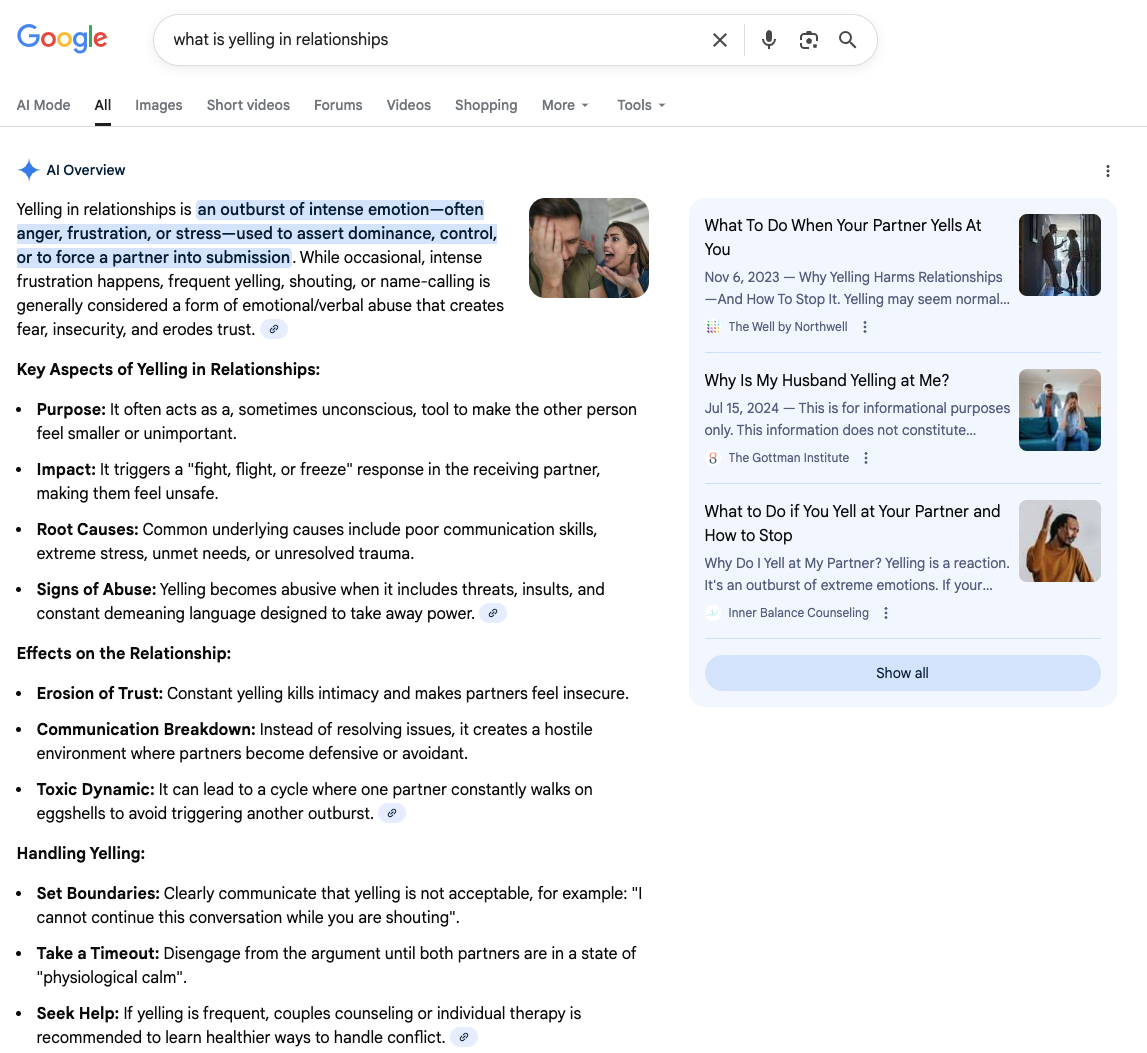
Let's take a look at the obvious - do a search for "what is yelling in relationships" ( note that there are even some opinions saying "it may be ok to yell" - I say bull, I say people who say that don't know the feck they are talking about, they haven't been on the receiving side of enough of it, or I don't know what their deal is, but I say yelling is NEVER OK, and I will not be compromising on this. Anyone who disagrees, is cordially invited to get nagged and yelled at, by someone who holds leverage over them, and see how they like it. I know some people will consider it normal, but that itself is not normal, in my opinion. They may have grown up with abuse, receiving and/or witnessing it, that doesn't make it ok. )
Mainstream expert' books mention this casually, with zero condemnation of this fact, and they even quote "healing the relationship" as motivation to clean up ( which is likely a false hope ).
> ( quote from BIT ) "Bill's adult daughter came to his house, yelling and nagging at him to get rid of his possessions..." ( while focusing solely on Bill's reaction and behavior following this, and zero condemnation or even consideration of daughter's behavior, or a potentially wider scope or impact, like the overall patterns and history of conflict in that family. Did Bill's wife or ex wife do the nagging and yelling ? Does she still do it ? Does Bill himself ? How often ? For how long ? When did it start ? How did it progress ? What was the timeline of dysfunction in possessions overall, and relative to that ? We don't know, and this might be very relevant. But Bill's daughter just nagging and yelling once, in isolation, without some wider pattern of nagging and yelling somewhere - that I would find hard to believe. )
> ( quote from BIT ) "I will be able to talk to my daughter without it turning into an argument about clutter, and maybe our relationship will get better.." ( that's a very flimsy maybe, and I would extend this doubt to all such prospects )
I would also suggest that the few explicit mentions of such conflict mentioned also vastly underrepresent the real deal - current or ex spouses making demands about the cleanup - how does that go behind closed doors ? Even if the researcher doesn't observe direct manifestations of conflict, there are more than likely to be happening, people are just on their better behavior in the presence of outsiders.
Personal example - I experienced nagging and yelling almost daily ; this was made known to social workers that we were working with - I told one of them the whole long and messy story - what came of it ? Nothing. They kept diagnosing me and considering cleanup and negotiating how to satisfy spouse's demands, while otherwise doing nothing except for listening, and nothing on the subject of abuse, coersion and the effect it has on me.
Let's also extend potential sources of nagging and yelling to one's job ( literally or figuratively ). A person might get exposed to plenty of tense, stressful situations at work, which would be functionally equivalent - feeling like your job is threatened every day, being compelled to overwork in an attempt to compensate or keep up. This is not even considered.
Let's look up "tacit approval" - if anything ever fit the description, it's this.
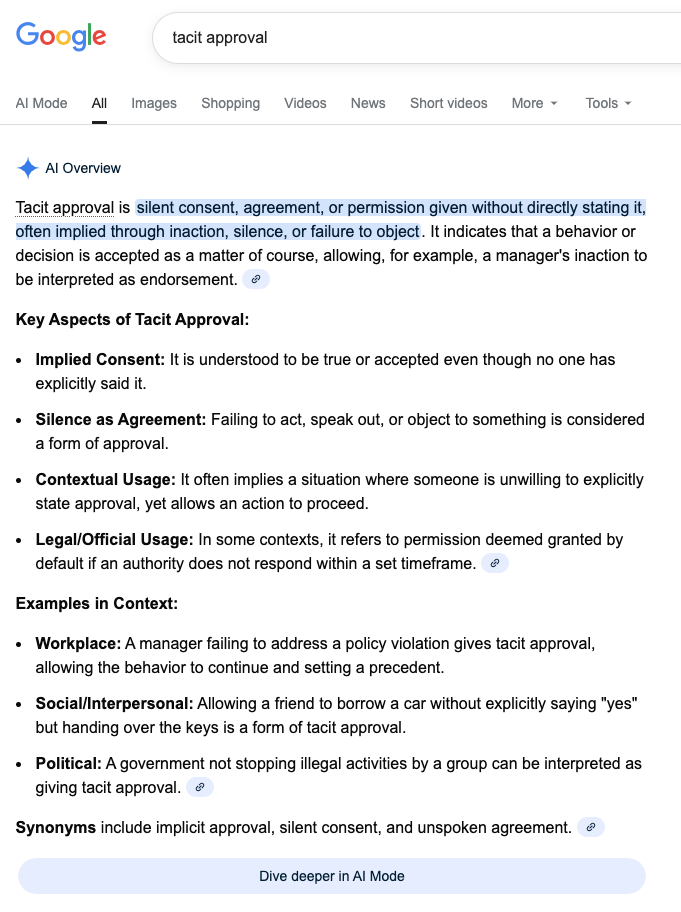
> silent consent, implied agreement, or authorization given without using words or formal, written acknowledgement. It occurs when someone implies approval by failing to object, not speaking out, or not acting to stop an action. It is often used in management, legal, and social contexts to represent a shared, unstated understanding
It's like observing a person get beaten up in an alley, and only examining their feelings or encouraging them to comply with the attacker, maybe the relationship will get better and the attacker will not beat them anymore.
But, I'm going to dig deeper and say it's a red herring, a canary in a mine.
I will suggest, based on logic and personal experience, that people usually behave better when an outside observer is present.
So, where there is one instance of "nagging and yelling" that is visible to the observer, there's going to be a whole lot more that isn't visible, both in scope and in time.
We can also go out on a limb and say nagging and yelling didn't just start yesterday, but has been happening for a long long time.
Maybe even.. before the "hoard" grew to anywhere close to its current proportions ? Maybe even.. before it started ? But even if not..
Also, "nagging and yelling" speaks about the person who's doing it - their approach to solving problems.
We can likewise go out on a limb and say that the same person doing "nagging and yelling" about possessions is very likely doing it for all sorts of other reasons.
Also, let's zoom in, pause and take in these words - nagging and yelling - what do they mean ?
Nagging. Definition -
> repeatedly asking or reminding someone to do something, often leading to annoyance, where a simple request becomes persistent, irritating communication because the initial message isn't acted upon, creating a cycle of offense and frustration for both parties in a relationship. It's defined more by the receiver's feeling of being bothered than the sender's intent, often starting as a normal reminder but escalating into persistent pressure.
Not quite as innocent as it sounds, I'd say. In fact, I'd say it's also a mild form of.. abuse - even in its most benign forms.
Even the mildest but recurring form of disagreement is liable to create disproportionate annoyance, stress, disruption, distraction.
Now, let's turn to yelling. Definition -
> an outburst of intense emotion—often anger, frustration, or stress—used to assert dominance, control, or to force a partner into submission. While occasional, intense frustration happens, frequent yelling, shouting, or name-calling is generally considered a form of emotional/verbal abuse that creates fear, insecurity, and erodes trust.
Wonderful, isn't it ? Quite innocent ?
This. This is what the mainstream authors tacitly approve by mentioning it with zero condemnation.
Yet, sources still treat these as legitimate means of communication.
Generally, articles like "X works better than nagging" arise, acknowledging and legitimizing it's use as something that's intended to work.
Let's now look at the effects of being on the receiving end of such communication.
You get yelled at, by your partner or another family member, in your own home.
What is the effect of that, on how you feel ?
Let me guess -
* Stress goes through the roof
* Heart rate, pressure spiking
* Fight or flight response, hijacking all attention, energy, memory, executive functions
* Safety of one's own home - violated - especially if the person doing the yelling has any leverage or influence on you
* Productivity plummets, if you happen to be engaged in any meaningful work requiring concentration
* Mistakes and forgetting happen
Now, word of caution - this may be a very sensitive issue, and must be approached delicately.
The person with possessions may be in a very vulnerable position - they may not be able to simply and easily leave, due to both sprawling, disorganized possessions, and a likely financial strain or inter-dependency.
This makes it all the more insidious.
And it gets worse.
Should you comply with "nagging and yelling" as a demand to discard your possessions, or to do anything ?
Quite aside from the merit of keeping any particular item or set of items -
Let's say you do comply - let's take a look what happened.
You just received a coercive, abusive demand, and you.. complied.
They applied coercive means of influence, and it apparently worked.
What will this do to their use of such means next time any disagreement arises ?
That's, right there will be more and more of it, and it will be harsher.
So, I would suggest that regardless of the question, complying with demands converyed via "nagging and yelling", is the worst possible thing you can do, it's like shooting yourself in the foot.
Like I said, one way or another, this is an extermely difficult, abusive and coercive situation that must be approached with caution, because when you are being abused in your own home, and the psychologists look on and tacitly approve it, there are no easy answers.
I could go on forever, and perhaps I will, but I will for now close this with the following -
Nagging and Yelling, either one or both, are abuse, plain and simple, and there is never an acceptable justification for these.
Never.
Nor is there an excuse for psychologists tacitly approving it.
p.s. And.. you guessed it - it gets worse.
Now let's ask the million dollar question - who would tolerate verbal abuse ( nagging and yelling being verbal abuse ), and why ?
Would an free, self-aware, self-sufficient person with awareness of the situation and a choice to leave or to reject the other person or to complel them to behave better tolerate verbal abuse ?
Somehow, I don't see that happening.
I would guess, only a person who has no choice in the matter would - a person who is in some way dependent on the abuser, or is unable or unwilling to leave or to compel the abuser to behave in a civil way - that's who.
In other words, a vulnerable person.
So, not only is it abuse, the person being nagged and yelled at is most likely in a weak, vulnerable position where they can't do anything about it.
There's a power imbalance happening, and the person doing nagging and yelling has more power, or at least that's how both perceive the situtation.
And, the same vulnerable person who is not entirely in control of the situation, is more likely to also be restricted from using adequate resources or space to deal with their possessions, and perhaps restricted in other ways, while being abused.
Now, what effect might this have on the person's ability to properly organize things, or even the basic executive function - in a restrictive, unfree environment full of conflict ?
It's also possible that abuse is mutual - two or more people may end up nagging and yelling at each other, and abusing each other in same or different ways - this cannot be excluded, nor the possibility that the Keeper is also an abuser - Keeper being the abuser, or an abuser, is no more or less likely, and is to be equally condemned.
But one thing is clear - nagging and yelling, in whichever direction, necessarily indicates the presence of an abusive, toxic situation and a vulnerable, dependent person or persons with no choice, and that must be taken seriously first and foremost, and all discussion of the dysfunction in possessions, excepting perhaps immediate health and safety concerns, should take a back seat to this, because this is an immediate, active harm and a red flag.
And it's not just theory - I have personally witnessed this exact dynamics - the victim of nagging and yelling can't do anything about it, and the abuser senses this, sees that there are no real consequences to the abuse, and the nagging and yelling and every other kind of disrespect only escalates.
This is what the "hoarding" "experts" ignore and condone, and they even encourage the abuser while placing all responsibility on the victim, without questioning the dynamics or raising any concern.
This is one of the many things that make me cringe when I read any of these helpful books on "hoarding".
Conclusions -
Nagging and Yelling is the smoking gun in the destruction of any relationship and in creating dysfunction in one or more people.
There CANNOT be healthy functioning in the presence of Nagging and Yelling. Simply impossible.
Any "therapist" who sees the smoking gun of nagging and yelling and then turns to the victim and starts asking them about their "attachment to their possessions" is not a therapist. They are a person who is either catastrophically incompetent or willfully ignoring a violent crime in progress.
Unfortunately, it appears, therapists are effectively powerless to recognize, point out and do anything about nagging and yelling situations. This comes from personal experience. A therapist of any denomination will listen, they might help a person take a load off from an extreme state of desperation, to feel better, but that's about it. Perhaps they are prevented by their "rules of engagement" from making accusations, from making any conclusions about a person not directly involved, and maybe even directly involved. They are highly unlikely to discover the real dynamics. The loudest complainer always runs the agenda, while the most civil, accommodating person loses. Therapists cannot hold the abuser accountable. They are obligated to call the police when they notice a threat to any person's life or health, but that's where it starts and ends.
Furthermore, I have a theory that a therapist, especially one invited for "Hoarding", will especially never recognize the real issues aside from Dysfunction in Possessions. WAYTA Blockage ( "What Are You Talking About?" - summary dismissal of all logic from the "Hoarder" ) comes into play. And they just don't have the right models, they aren't trained to ask the right questions - all they focus on is the issue they are invited in on, maybe the relationship, but primarily it's just about feelings. It's like asking a caveman to fix a supercomputer. You know what happens.
I'm not saying any given therapist didn't do their best - perhaps they did, perhaps they played by their rules of engagement, their training.. But it's those very things that preclude them from actually being able to do anything.
See also:
* "Tough Love" is a Euphemism for Disrespect, Coercion and Abuse ( similar structure )